
On-site protection, handling and installation
Getting the best from your glulam components starts well before installation. Following good site management practices from delivery through to fixing helps protect your structural warranty and keeps your timber looking its best for years to come.
Find more detailed guidelines for glulam:
On-site protection and moisture control guidelines for glulam
To preserve the structural performance and premium visual finish of your glulam from delivery through to final handover, please follow these protection guidelines:
Factory wrapping: All glulam components are dispatched unsealed, but are securely factory-wrapped to provide physical protection during transit and initial handling.
Mandatory on-site sealing: A appropriate protective coating system must be applied to all exposed faces within two weeks of product acceptance (immediately upon unwrapping).
Permanent coating: Permanent weather-protection coatings should be applied shortly after unwrapping to guarantee long-term durability and an optimal finished appearance.
CRITICAL REQUIREMENT: All site-applied sealers and final coating systems must be solvent-borne or oil-based (such as a turpentine-based system). DO NOT coat glue laminated timber with any water-based product. Water-based coatings introduce moisture into the kiln-dried timber cells, causing rapid swelling, shrinking, and severe surface checking.
Temporary or permanent site coatings provide vital protection during the construction phase and typically fall into two categories:
Translucent sealers (low-solid content): Designed for limited on-site exposure times when the final design specifies a clear or stained finish. Note: If using stains on exterior members, avoid dark colors to minimize heat absorption and timber movement.
Primers & non-penetrating sealers (high-solid content): Formulated with a minimum 25% solid content to seal the glulam surfaces completely. These film-coatings must be monitored and maintained on-site; any fractures or deterioration in the film will allow moisture ingress.
Guidelines: For more detailed information on options, pros and cons and guidelines, go to Coating and Colour page.
Critical detailing & compatibility check:
Compatibility check: Always ensure that your temporary on-site sealer is fully compatible with the final intended finish (stain, sealer, or paint). Select your site sealer or coating based on how long the timber is anticipated to be exposed on-site before full building enclosure.
Reseal all modifications: Particular attention must be taken to heavily seal exposed end grains, on-site cuts, drilled holes, notches, and slots immediately during framing and installation.
ON-SITE SEALING REQUIRED!
Our glulam products are supplied unsealed. To prevent moisture damage, a solvent- or oil-based sealing system must be applied to all faces within 2 weeks (upon unwrapping). **Do not use water-based coatings.**
Handling guidelines for glulam
To protect the premium visual edges and structural integrity of your glulam beams, please ensure your site crew follows these handling protocols:
Protect the surface: Handle beams with care. Never drop, drag, or violently jar glulam members, as this can bruise the timber and compromise the protective factory wrapping.
Secure transport: Ensure all loading, unloading, and tie-downs during transport utilize methods that protect the corners, finished faces, and packaging from strapping damage.
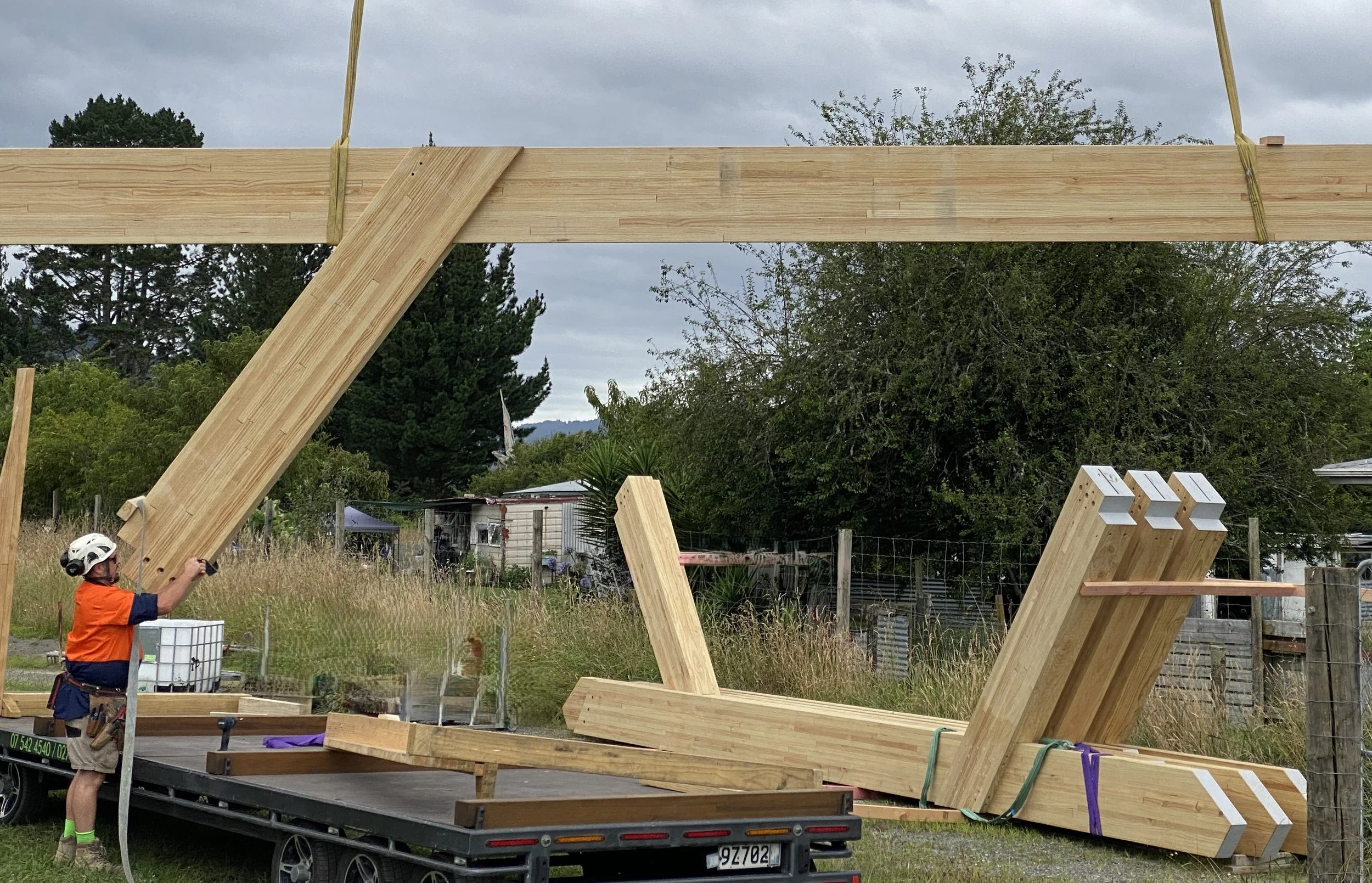
Use the right slings: Lift using wide nylon webbing slings to avoid crushing the timber edges. If chains or wire ropes must be used, heavy-duty corner protection is mandatory.
Lift on edge: Always lift and carry glulam beams on their vertical edge wherever possible. For long spans, use a proper spreader bar to prevent excessive bending or over-stressing during erection.
Control the lift: Position your slings carefully to guarantee a balanced load, and always use guy lines (tag lines) to maintain full control of the beam while it is in the air.
Site storage guidelines for glulam
Proper storage on-site prevents moisture uptake, bowing, and UV damage before your glulam is erected. Please ensure your site crew adheres to the following layout and storage recommendations:
Leave wrapped: Keep our factory transit wrapping intact as long as possible before installation.
Keep clear of the ground: Stack glulam in a well-drained position, well clear of the ground and completely free of puddles or vegetation.
Always use fillets: Place timber fillets (dunnage) between the ground and the beams, and between layers of beams. This ensures continuous air circulation across all four surfaces and prevents structural warping.
Store under cover: Keep beams fully under cover or under a secondary tarpaulin during the construction phase to shield them from direct rain and extreme heat.
Use drainage splits: If the glulam is being stored on-site for an extended period, carefully split the plastic wrapping along the underside of the beam. This allows any accidentally trapped rainwater or condensation to drain out freely instead of pooling against the wood.
Avoid over-drying: Do not store glulam near artificial heat sources or leave it baking in unventilated, high-heat environments. This rapidly drops the timber's moisture content, leading to surface splits and checking.
Never partially remove or tear back the wrapping: If one section of the timber is exposed to UV light while the rest stays covered, it will cause uneven, patchy weathering that ruins the visual grade.
Installation and fixing guidelines for glulam
When it is time to install and fix your glulam beams and posts into position, ensure your site crew follows these structural and protective guidelines:
Reseal all site cuts immediately: Where members are cut, drilled, notched, or processed on-site, the exposed, unprotected timber must be immediately resealed with a protective coating to prevent moisture ingress.
Avoid unapproved notching: Never notch, rebate, or drill into the tension or compression flanges of glulam beams without authorization. The project designer or engineer must be consulted before any such modifications are carried out, as it can severely compromise the beam's structural integrity.
Use rust-proof fittings: Always use rust-proof, galvanized, or stainless steel fasteners. Unprotected, ordinary steel can react with the timber when exposed to rain, creating permanent, ugly dark stains across the visual face of the wood.
Prevent soil and debris build-up: For both in-ground and surface-mounted posts, you must prevent soil, mulch, and debris from building up around the bases or ends of the timber. Trapped debris holds moisture against the wood and will eventually degrade even treated timber.