
Coating and Colour
Choosing an appropriate coating and colour system is critical for maintaining the striking appearance and durability of our glue laminated timber.
Explore coating options used by our customers to achieve their desired appearance, along with practical pros and cons to help you select the right system for your project.
Note: This reflects our experience with these products and may not cover every aspect. Please confirm application, maintenance, and performance details with the coating manufacturer.
Find more details on:
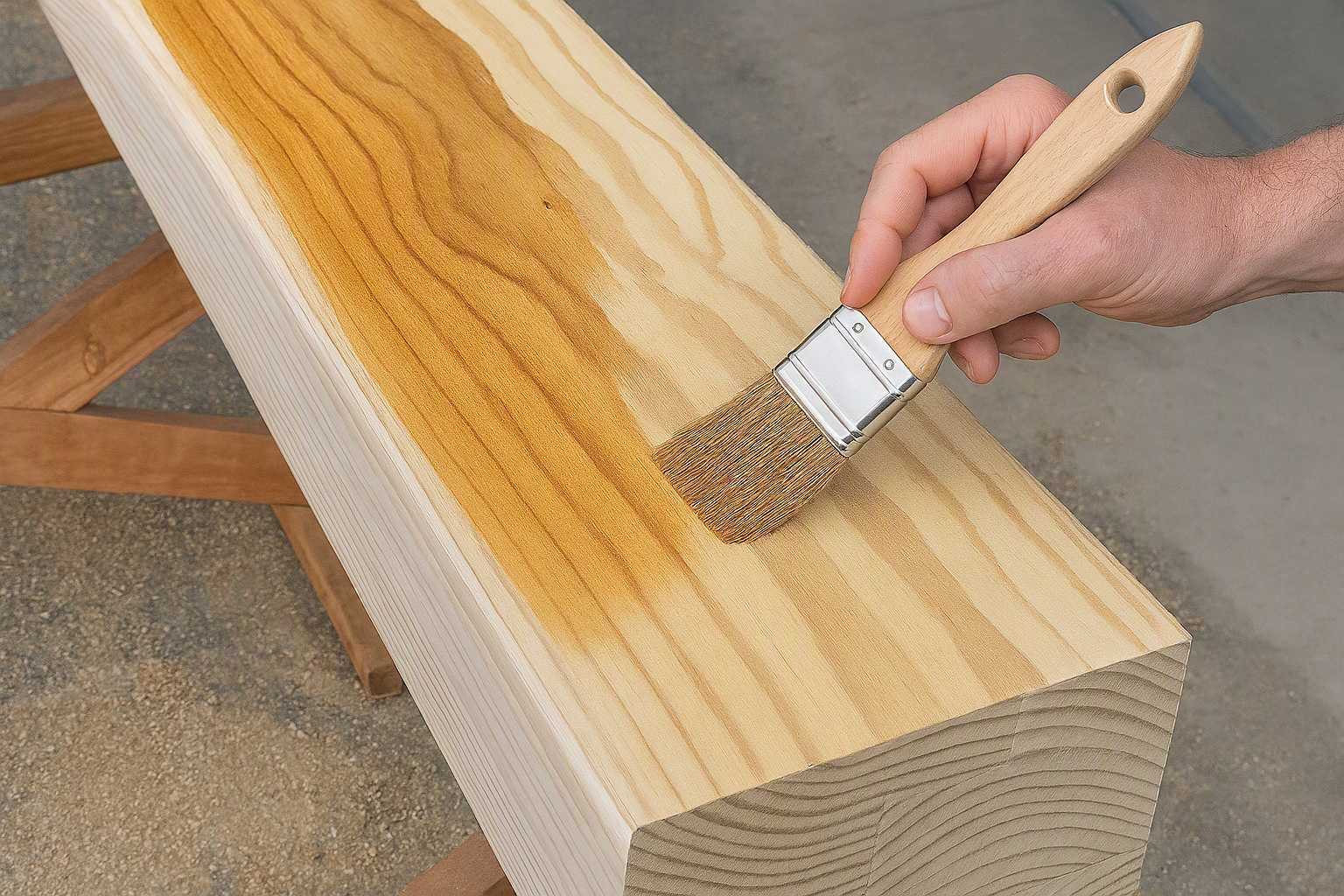
Selection - Key Considerations
Colour and coating are critical choices for the appearance and durability of your laminated timber. Here are key considerations to help you make the best choice.
Internal
Good news, if you're using laminated timber indoors, you've got plenty of freedom with colour and coating. Indoor conditions stay pretty stable, so there won't be much movement in the timber, and your finish will look great for years. The main thing to think about is how the coating handles everyday wear like touch marks, knocks, and how easy it is to wipe clean.
External
Outdoors is a different story. Sun, rain, and changing temperatures make timber expand, contract, swell, and shrink. If the coating can't keep up with that movement, you'll start to see fine cracks or separation of wood fibres (called "checking") in the timber. So outside, it's worth taking a bit more care matching your colour and coating to how the timber will be used.
Two ways to protect your timber:
Penetrating oils soak into the timber and protect it from within. They won't crack or peel, but the oil naturally wears away over time, so you'll need to apply it more regularly. Think of it like moisturising the wood.
Paints and varnishes sit on top of the timber like a protective shell, sealing out moisture. They look great, but once the coating chips, cracks, or wears through, damage can spread quickly underneath. When it's time to maintain them, you’re looking at filling, sanding, and repainting.
A few simple considerations to help you decide:
Colour
Stick to lighter colours, >45% Light Reflectance Value. They reflect more heat and are less harsh on the timber long-term.
Love a dark colour? Here’s what you need to know about dark colours before you commit.
Coating
Want to see the natural wood grain? Go with an penetrating oil or a UV-protective varnish.
How often do you want to maintain it? Oils need a little TLC often (easy top-ups), while paints and varnishes need attention less often but it's more work each time.
Want the best of the best?
If you want a finish that really goes the distance, ask about Accoya timber. It absorbs up to 80% less moisture than standard timber, which means visual issues like checking and delamination are virtually eliminated and you get a premium quality longer-lasting finish.
Whatever you choose, applying it properly and keeping up with maintenance is the secret to keeping your timber looking great for the long haul.
Internal - Clear Coat (Grain visible)
Product: Polyurethane
Examples: Resene Aquaclear (water based) or Resene Qristal (water based)
Use: Follow the manufacturers’ instructions for preparation and application.
Pros:
Provides durable coating with good wear properties and easy cleaning
Highlights the full timber grain and colour
Cons:
Three to four coats may be required
Maintenance and repairs require sanding back and multiple coats
No UV protection so exposed timber may change colour and silver faster than protected timber
Internal - Oil (Grain visible)
Product: Penetrating Oil with colourtone added
Examples: CUTEK® Euro - clear with colourtone, Dryden WoodOil - clear with colourtone
Use: Two coats are required on new timber. Using CUTEK Extreme CD50, the second coat can be applied 1-2 days from initial application. With Dryden WoodOil, the second application can only be done 40 days after the initial application. Follow the manufacturers’ instructions for preparation and application.
Pros:
Maintains consistent look to your project because weathering due to UV is minimised, meaning timber exposed to the sun will maintain a colour similar to timber in the shade.
Many colour tone options to enhance your project
Fast and easy to apply
Easy to clean and reapply for maintenance
Damage to timber surface or occurrence of checking does not impact protection
Cons:
Penetrating oil weathers out of timber and regular reapplication is required (may be as frequent as 2 years for highly exposed timber)
Timber in high traffic/touch areas may dis-colour through dirt/body oils and be difficult to clean.
Internal - Paint (No grain visible)
Product: Paint
Examples: Resene Wood Primer (oil based) then any topcoat, Dulux 1Step® Prep Oil Based Primer Sealer Undercoat and then any topcoat
Use: Follow the manufacturers’ instructions for preparation and application.
Pros:
Long lasting UV protection
Durable easy clean surface finish
Any colour along with a variety of gloss choices
Cons:
Two to three coats may be required
Maintenance and repairs require sanding back and multiple coats
External - Oil Silvered (Grain visible)
This ‘weathered’ finish gives an aged look to pine timber after 3-6 months exposed to sun and weather. Don’t be tempted to leave the glulam uncoated to achieve this look as the warranty will be void and you will accelerate the deterioration of you products, impacting structural integrity and visual appearance.
Product: Penetrating Oil (Clear)
Examples: CUTEK® Extreme CD50 - clear (no colourtone), Dryden WoodOil - clear (no colourtone)
Use: Two coats are required on new timber. Using CUTEK Extreme CD50, the second coat can be applied 1-2 days from initial application. With Dryden WoodOil, the second application can only be done 40 days after the initial application. Follow the manufacturers’ instructions for preparation and application.
Pros:
Fast and easy to apply
Easy to clean and reapply for maintenance
Damage to timber surface or occurrence of checking does not impact protection
Cons:
Penetrating oil weathers out of timber and regular reapplication is required (may be as frequent as 1-2 years for highly exposed timber)
Exposure to UV and weather will dictate how quickly weathering occurs meaning silvering will occur at different rates
Reapplication of the clear penetrating oil as part of maintenance will visually change the appearance of the timber before it weathers again
External - Oil Tinted (Grain visible)
Product: Penetrating Oil with colourtone added
Examples: CUTEK® Extreme CD50 - clear with colourtone, Dryden WoodOil - clear with colourtone
Use: Two coats are required on new timber. Using CUTEK Extreme CD50, the second coat can be applied 1-2 days from initial application. With Dryden WoodOil, the second application can only be done 40 days after the initial application. Follow the manufacturers’ instructions for preparation and application.
Pros:
Maintains consistent look to your project because weathering due to UV is minimised, meaning timber exposed to the sun will maintain a colour similar to timber in the shade.
Many colour tone options to enhance your project
Fast and easy to apply
Easy to clean and reapply for maintenance
Damage to timber surface or occurrence of checking does not impact protection
Cons:
Penetrating oil weathers out of timber and regular reapplication is required (may be as frequent as 1-2 years for highly exposed timber)
External - Varnish Tinted Gloss (Grain visible)
Product: Flexible film forming
Examples: Sikkens Cetol HLSe and Sikkens Filter 7 Plus system
Use: Follow the manufacturers’ instructions for preparation and application
Pros:
Long lasting UV and weather resistance
Premium satin look
Flexibility to accommodate movement of timber and slight checking
Breathable to regulate moisture
Resistance to peeling and flaking
Cons:
Maintenance recoats require sanding to ensure proper adhesion
External - Paint (No grain visible)
Product: Paint
Examples: Resene Wood Primer (oil based) then any topcoat, Dulux 1Step® Prep Oil Based Primer Sealer Undercoat and then any topcoat
Use: Follow the manufacturers’ instructions for preparation and application.
CRITICAL REQUIREMENT: Do not use paint with a Light Reflectance Value (LRV) of less than 45%. Dark colours attract excessive heat, dropping the timber’s moisture content and causing structural splitting, resin bleeding, distortion, and cracking.
Pros:
Long lasting UV and weather resistance
Any colour along with a variety of gloss choices
Cons:
Two to three coats may be required
Maintenance and repairs require sanding back and multiple coats
Moisture can become trapped beneath the paint layer if the coating is punctured, scratched, or improperly sealed at the end grain
External - Dark or Black
Modern architecture and colour schemes increasingly favour dark colours but when paired with timber, dark colours can cause both visual and structural problems. Dark surfaces absorb more heat, and that extra heat causes the timber to expand and contract more than it would with a lighter colour. Over time, this movement leads to checking (fine surface cracks), which lets moisture into the timber. Once moisture gets in, the checking and splitting only get worse.
If you plan to use dark colours, then expect more visual defects and plan to maintain your product more frequently to ensure structural integrity.
While using dark colours may not entirely void your warranty it will have these impacts:
Issues such as checking, fine splits, timber tear will not be covered by the warranty
Structural integrity is covered until checking/tearing effects the product
Timber treatment and durability is still covered.
We recommend using colours and coatings that have light reflectance values (LRV) greater than 45%.
Light Reflectance Value (LRV)
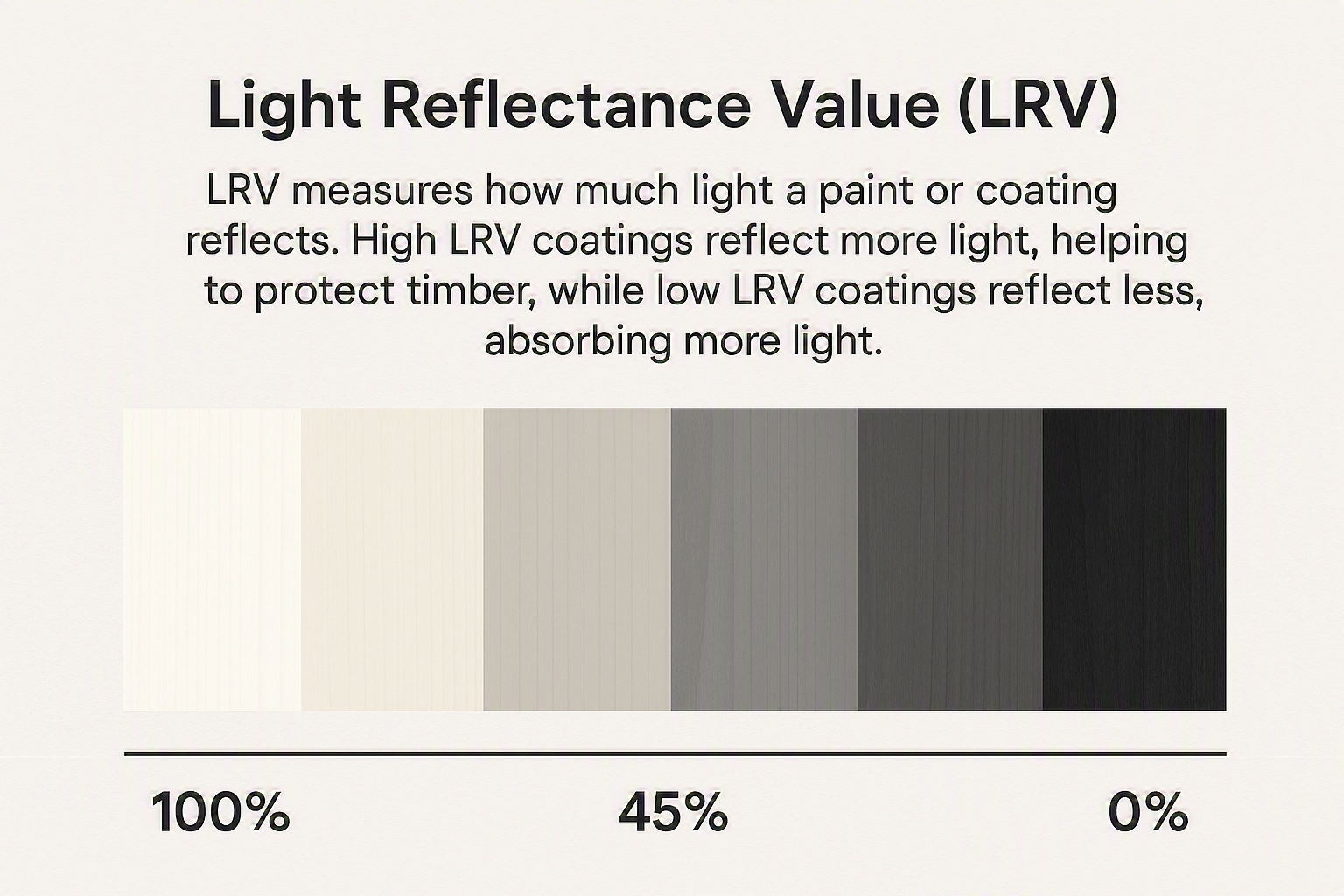
LRV measures how much light a colour reflects versus absorbs, on a scale from 0-100%.
100% (white) → reflects almost all light
0% (black) → absorbs almost all light
So
High LRV (light colours) = more reflection, less heat absorption
Low LRV (dark colours) = less reflection, more heat absorption
Why LRV matters for timber
Heat build-up - Dark (low LRV) coatings absorb more sunlight, so the timber underneath gets hotter. Light (high LRV) coatings reflect sunlight, keeping the timber cooler.
Movement and stress - Heat makes timber expand and contract. More heat means more movement, which can lead to checking and fine fiber separation, warping and coating failure.
Coating durability - Higher temperatures make paint break down, peel, or blister faster. Lighter colours generally last longer on timber because they put less heat stress on both the coating and the timber underneath.
Rule of thumb
Choose a higher LRV (lighter colours) for better protection and longevity.
Be cautious with low LRV (dark colours) on timber exposed to direct sun.
Coatings with an LRV below 45% may affect your warranty.